


Introduction: The paradox of efficiency investment
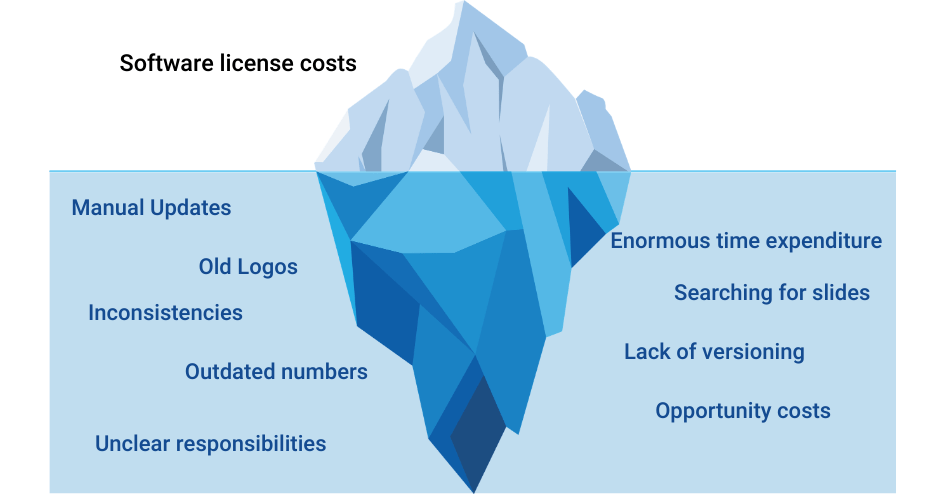
Companies are increasingly recognizing the need to modernize their knowledge and collaboration work. Nevertheless, many are reluctant to invest in efficiency tools. The main reason is a cognitive cost paradox: visible, immediate costs such as licenses, implementation and conversion dominate the decision, while less tangible gains through time savings, error reduction and improved compliance are systematically underestimated.
Added to this is the psychological hurdle of loss aversion – what seems familiar is preferred to what is better, even if the hidden costs of “business as usual” far exceed the investment. This paradox means that considerable potential for increasing efficiency in the company remains untapped.
Visible costs, invisible profits: where management often falls short
The hidden costs of the current situation add up to considerable sums. Employees regularly spend hours a week searching, compiling, coordinating and versioning content. Manual work such as copying, formatting and updating multiple files ties up valuable capacity.
Particularly critical are error and reputation risks due to outdated figures, old logos or incorrect disclaimers. Added to this are process friction due to email loops, unclear responsibilities and a lack of traceability. The biggest losses often arise from opportunity costs: delayed market launches, less time for customer meetings and limited innovation capacity.
From the general to the concrete: Processes in presentation and document management
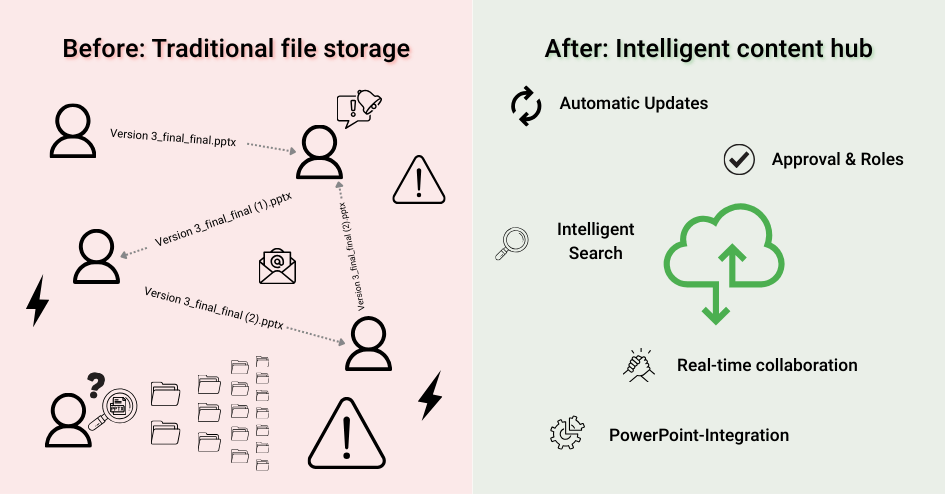
Nowhere are inefficiencies more noticeable than in the management of presentations, sales documents and product sheets. Content is scattered across drives, SharePoint, email attachments and personal folders. The resulting versioning chaos leads to multiple, often contradictory versions circulating, while no one knows for sure what has been approved.
When key figures, logos or disclaimers need to be updated, this often means opening, adapting, checking and saving dozens of files individually. An enormous amount of time with a high risk of errors. Brand inconsistency due to differing templates has a negative impact on brand perception. Compliance and liability risks are even more critical if unapproved or outdated content reaches external stakeholders.
Studies confirm this: A significant proportion of knowledge work is spent searching, coordinating and updating. The manual updating of multiple slides or approval via email loops alone regularly costs teams several hours per week – time that cannot be used to add value.
How modern content hubs resolve the paradox
Modern content hubs transform static file repositories into active, process-controlled systems. They act as a central source of truth in which maintained, approved content is always up-to-date and easy to find. Dynamic links ensure that key figures, logos or diagrams only need to be updated once and are then automatically up-to-date everywhere.
Roles, rights and approval workflows are anchored directly in the process. Versioning, validity rules and automatic reminders significantly reduce the workload for teams. AI-supported search functions replace tedious folder searches with context-based findability. Integration in PowerPoint and connection to existing systems ensure smooth workflows.
The result: significantly reduced search and maintenance effort, minimized error rates, consistent brand communication and accelerated time-to-market. The increase in efficiency within the company is realized systematically and measurably.
Leanr: The specialized content hub for presentations and documents
Leanr focuses precisely on the efficient, secure and brand-compliant creation, maintenance and playout of presentations and documents. Central content components such as slides, graphics, figures and disclaimers are maintained once and dynamically updated in all linked presentations.
Role-based approval processes ensure that only checked, up-to-date content is used. Templates and brand guidelines are technically enforced and deviations are prevented. Validity periods and automated notifications systematically minimize risks.
Particularly important: Leanr ensures that no outdated or incorrect information leaves the company. Risks are systematically eliminated through dynamic links, process rules and mandatory approvals – a quality and compliance advantage that goes beyond pure efficiency. The team of experts takes care of structuring, migration and training with minimal disruption to day-to-day business.
Practical process examples
–Traditional
- Open each file individually and adjust manually
- At 5 minutes per file: over 4 hours of work (for 50 presentations)
- High risk: At least one file gets overlooked → inconsistent figures
✔With Content Hub
- Update a key metric once, centrally
- All linked presentations automatically pull the new version
- Guaranteed consistency and time savings across the entire organization
–Traditional
- Email chains with different versions
- Unclear responsibilities and traceability
- Risk: Unapproved versions reaching the customer
✔With Content Hub
- Tasks are assigned automatically
- Every step is documented; reminders for delays
- Sales sees exclusively approved versions
Profitability from month 1: A conservative example calculation
A medium-sized company with 250 employees, 160 of whom are regularly involved in presentation work, serves as the basis. Conservative assumptions: Currently, 3.0 hours per person per week are spent on creating, searching, updating and coordinating. A content hub with automation and central modules can realistically save 35%. At a full cost hourly rate of €60, this results in
- Hours saved per month: 160 people × 3.0 h/week × 35% × 4.3 weeks ≈ 722 hours
- Monetary effect per month: 722 h × € 60 ≈ € 43,320
Even if training and conversion are priced in, specialized providers take care of this methodically. In most license scenarios, the monthly savings significantly exceed the total costs. A positive ROI can typically be achieved within the first month.
Every additional half hour saved per week and user equates to around €20,640 in additional savings per month. Even small process improvements therefore have a considerable leverage effect.
Additional, non-monetized benefits
In addition to direct cost savings, the increase in efficiency in the company has other effects: Quality gains through uniform brand management and improved customer experience. Significant risk reduction due to fewer liability cases with complete traceability. Increased employee satisfaction thanks to less frustration and more time for value-adding work. Strategic agility through faster time-to-market thanks to clear workflows.
Conclusion: consciously resolving the cost paradox
Those who only consider the visible license and conversion costs fail to recognize the considerable, recurring process costs in the status quo. In the area of presentation and document management, these inefficiencies can be systematically eliminated with a specialized content hub. The automation of routine processes, combined with intelligent governance and dynamic links, achieves productivity effects that exceed the license costs in the first month in typical setups.
Specialized solutions such as Leanr also ensure that no outdated or incorrect content leaves the company – a key protection against reputational and liability risks that goes far beyond pure efficiency gains.
Further information: Whitepaper “Optimization of presentation management”
For detailed insights into challenges, solution architectures and measurement methods, we recommend the white paper “Optimizing presentation management – the benefits of intelligent software solutions”. It provides an in-depth look at how central content hubs, smart versioning and automatic updating can increase efficiency within the company and resolve the cost paradox in practice.