

Sales enablement in practice: turning theory into real sales performance
How many tools does a sales department need to establish truly efficient sales processes? And why do so many sales enablement initiatives fail when faced with the reality of day-to-day business?
Anyone with operational responsibility as a sales manager knows that it’s not about overloaded features, but about a sales enablement tool that actually simplifies day-to-day sales processes and creates real added value for sales teams.
Sales enablement tool: More than just content management
Many solutions promise to optimize sales processes – but in the end, all that often remains is another filing system. A modern sales enablement tool needs to do much more:
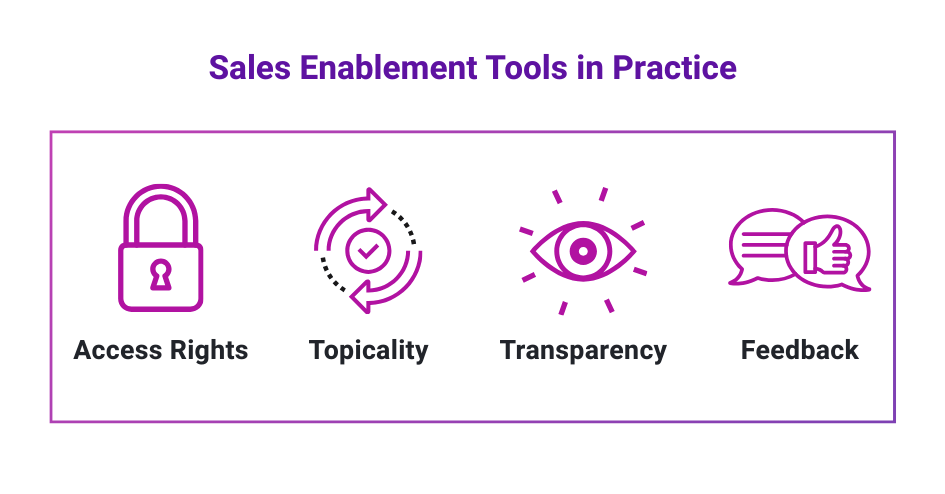
- Clearly control access rights: everyone only sees what they really need. Sensitive information remains protected and the overview is maintained – a must for efficient sales processes.
- Up-to-date instead of document chaos: changes to product information, prices and presentations are available immediately – no more outdated versions in circulation.
- Time: In sales, things often have to happen quickly. A tool must enable every user to reach their goal quickly and efficiently
- Transparency and compliance: Who changed what? Which version applies? Everything is traceable, everything is documented in an audit-proof manner.
- Direct feedback: Sales staff can use content directly, but also rate and comment on it, and suggestions for improvement flow directly into the system – making sales enablement a continuous process.
Everyday situations with customers – and how sales enablement really helps
Operational sales means everyday customer meetings. This is where the wheat is separated from the chaff: does the sales enablement tool solve real problems in sales – or does it remain a theory?
Example 1: Ad-hoc meeting at the customer’s premises:
A sales manager is sitting at the customer’s premises and the price structure has changed the day before. Instead of frantically searching through emails, he opens the latest version in the sales enablement tool – with exactly the information approved for this customer group. The sales processes run smoothly and the deal is closed successfully.
Example 2: New product line, immediate implementation:
Marketing introduces a new product line. The documents are automatically provided to the responsible sales employees via the sales enablement tool. Nobody works with outdated presentations any more – sales processes are automatically kept consistent, intuitive and up-to-date.
Example 3: Proof of compliance at the touch of a button:
During an audit, the question arises as to the approval history of a technical data sheet, a disclaimer or similar. No problem: the sales enablement tool clearly documents who made which change and when. This supports sales management and creates trust.
Example 4: Immediate feedback:
A new argumentation paper lands in the system – and of course some typical customer questions remain unanswered. Why accept these gaps? The feedback is passed on directly to the team responsible by means of a targeted comment. The result: continuously improved materials that actually stand the test of time.
Sales enablement vs. sales management: what’s the difference?
Sales management means defining the strategic direction, setting targets and managing sales on this basis. You can find out more about this here: Content hub as a driver of success – how to revolutionize your sales management
Sales enablement, on the other hand, is operational: it equips teams with the tools, information and processes they need on a day-to-day basis to successfully implement sales processes.
Plain text:
- Sales management sets the direction.
- Sales enablement ensures that sales processes run smoothly – and that the sales team is on the road with the best equipment.
Efficiency gains and increased productivity – backed up by figures
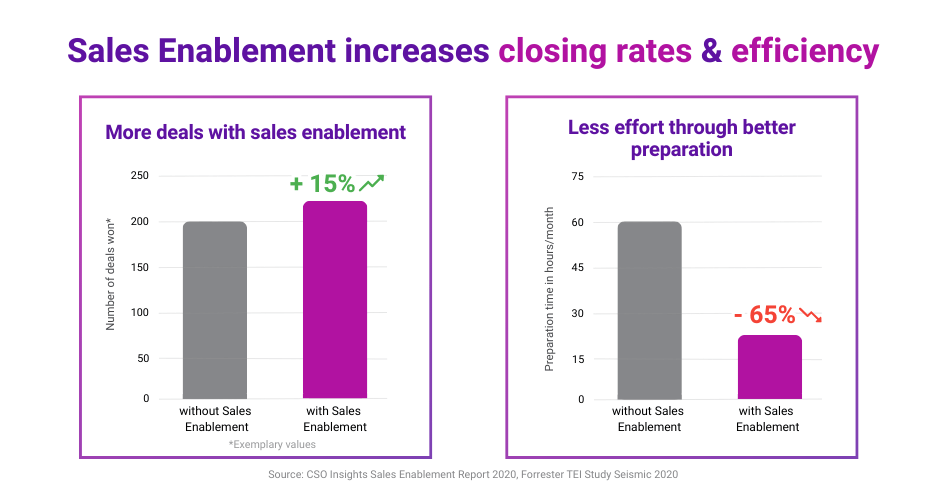
The benefits of an intelligent content hub are no longer an assertion, but measurable: according to a study by CSO Insights, companies with a systematic sales enablement approach achieve a 15% higher closing rate than companies without dedicated enablement measures (CSO Insights Sales Enablement Report 2020). At the same time, the average preparation time for customer appointments is significantly reduced: according to a Forrester study, companies report a reduction in preparation time of up to 65% when a sales enablement tool is used (Forrester TEI Study Seismic 2020).
Another plus point: the transparent usage analysis shows exactly which content is actually being used in the sales processes. This allows sales teams to develop their content strategy in a targeted manner and focus resources on formats that have a proven impact.
Customer feedback: Enablement in the application
What does this look like in reality? Companies that consistently focus on user-friendliness and active change management when introducing a sales enablement tool quickly achieve measurable success. The sales enablement tool becomes a real competitive advantage and strengthens sales processes operationally.
Example from the financial sector:
DZ-Privatbank uses Leanr as a modern sales enablement tool to provide advisors with optimal support during customer meetings. Current customer feedback confirms this:

You can find more reference examples from practice at: https://leanr.one/en/reference-examples/
Change management: the underestimated success factor in sales enablement
The best technology is useless if it doesn’t reach the team. Successful change management determines whether a sales enablement tool becomes the backbone of sales processes – or withers away in the shadow of old routines.
Example of failed implementation:
Elsewhere, the sales enablement tool is introduced “top-down”. Training is superficial, queries are dismissed. After six months, less than 20% of sales staff are using the tool regularly, sales processes continue to run using old Excel lists and templates, and sales management is still flying blind.
Example of successful implementation:
A medium-sized company involves the sales team at an early stage, provides targeted training and starts with pilot groups. The benefits of the sales enablement tool are made tangible, users are guided intelligently and situation-specifically by the software and feedback is incorporated directly. After three months, 90% of sales staff are actively using the tool, sales processes are demonstrably more efficient, faster and more accurate and sales management receives valid data.
Conclusion: Operational added value is decisive – not the tool alone
Sales enablement is not an end in itself and not just another filing system. It is the backbone of operational sales processes – provided it is consistently aligned with the real requirements of the sales teams. This is also shown by a recent study: companies with an established sales enablement program achieve 84% of their sales targets, compared to only 59% without structured enablement (CSO Insights, Sales Enablement Report 2022). The difference is clear – and underlines the fact that operational added value does not come from the technology, but from the precise implementation.
If you want operational excellence as a sales manager, you need to simplify processes, create transparency and take feedback seriously. Only then will sales enablement become a growth driver – and sales management can unfold its full effect.