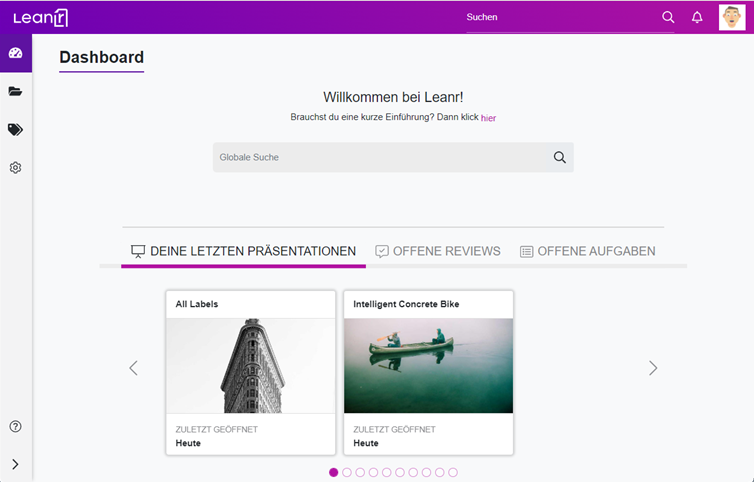



Most companies treat presentations like ordinary files – a costly mistake that destroys valuable time and business opportunities every day.
In companies worldwide, thousands of presentations are shared every day via SharePoint, internal wikis or intranet platforms. What looks like order at first glance turns out to be organizational chaos on closer inspection: sales employees frantically search through folder structures for the latest product presentation, while marketing teams lose track of released versions. These scenarios play out every day in companies of all sizes – from medium-sized businesses to international corporations.
The problem lies deeper than many managers suspect. Presentations are no longer static documents – they are living communication tools that are constantly evolving and have a significant impact on the success of customer meetings. At a time when decisions have to be made faster and faster and the quality of communication determines business success, companies simply can no longer afford inefficient presentation processes. Nevertheless, in most organizations they are still treated like ordinary Word documents – an approach that not only costs time, but also poses significant business risks.
An IDC study shows that these risks are real: according to the decision-makers surveyed, inefficient document workflows not only reduce the productivity of the entire company (-44%), employee satisfaction (-40%) and customer satisfaction (-35%) also suffer significantly (IDC, 2016). In an increasingly data-driven environment, efficient presentation management is therefore becoming a decisive competitive factor.
The hidden costs of outdated presentation systems
SharePoint and classic intranet solutions undoubtedly fulfill important functions – they perform well when it comes to sharing general documents or managing policies. These platforms were originally developed for the management of static content and still perform this task reliably today. However, dynamic presentation processes quickly reveal their structural weaknesses, which go far beyond technical limitations and impair fundamental business processes.
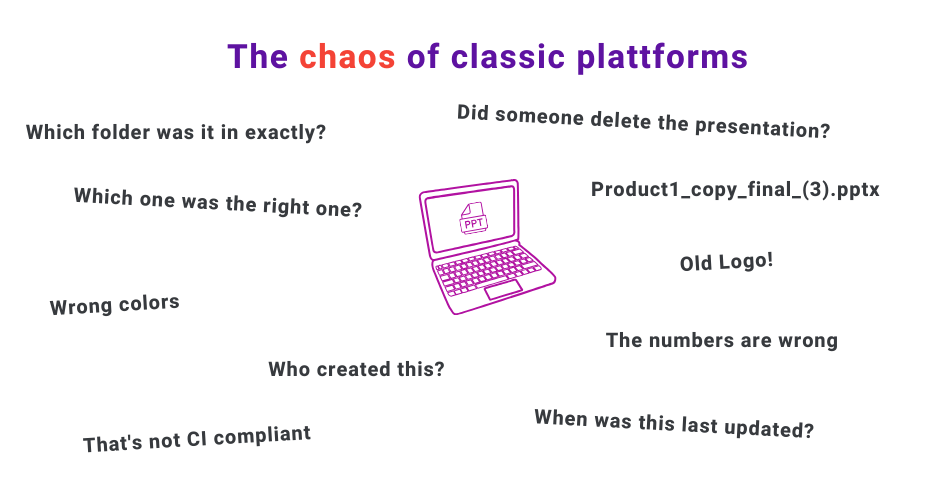
A typical example is the rebranding process: when a company introduces a new corporate design, countless existing presentations have to be adapted. In SharePoint or intranet solutions, this often means tedious individual work, lengthy searches for the right files and a high susceptibility to errors – with the result that different versions are in circulation in parallel.
Version chaos costs time and credibility
If your sales team arrives at a customer meeting with an outdated price list, it’s more than just inefficient – it’s damaging to business. Missing or unclear versioning means that outdated or incorrect presentations continue to circulate, while current content disappears into the depths of the folder structure. The problem increases exponentially if several departments are working on similar presentations at the same time or if content has to be adapted for different target groups. The result is not only embarrassing situations in customer meetings, but also a considerable loss of trust. Employees also lose valuable time trying to find out which version is the latest instead of concentrating on their actual tasks. A central content hub can avoid these problems.
Release processes become time wasters
Unstructured approval processes lead to uncertainty and unnecessary effort. Marketing teams spend a lot of time trying to find out which presentations have already been approved. At the same time, sales employees are often unclear about which content is up-to-date and usable. For fear of making mistakes, presentations are checked several times – which slows down processes considerably. The result: instead of concentrating on customer meetings, teams lose valuable time searching, coordinating and checking – time that could go directly towards sales success. In addition, cross-departmental collaboration suffers greatly from these inefficiencies.
Our blog describes in detail what an efficient, connecting solution can look like – find out more in this article.
Lack of transparency and retrievability
Another serious problem with traditional presentation systems is the lack of transparency. Presentations are scattered in different folders, sent by email or saved locally – often without a clear structure or standardized naming. Even simple tasks such as finding the latest version of a product presentation can turn into time-consuming searches. Valuable content gets lost or is recreated several times because it can simply no longer be found. This results in unnecessary duplication of work and knowledge remains hidden in silos.
What modern presentation management really means
Successful presentation management starts where traditional filing systems stop. It’s not just about managing files, but about orchestrating the entire content lifecycle – from the initial idea to the final customer presentation. Modern approaches see presentations as strategic assets that need to be actively managed, continuously optimized and intelligently networked.
A well thought-out system is characterized by several core functions: Central maintenance ensures that changes are automatically transferred to all downstream, relevant presentations. Clear distribution of roles and rights creates traceable responsibilities and approval processes that guarantee both security and efficiency. Intelligent search functions make finding suitable content child’s play, while analytics tools provide insights into the use of various presentations. Seamless integration into existing workflows is particularly important. A professional content hub acts as a central hub for all content.
Practical example: How structured presentation management is revolutionizing sales
Imagine if your sales team could access the perfect, up-to-date presentation at any time – personalized for the respective customer, checked by the legal department and visually consistent with your brand identity. What sounds like a dream is already a reality with the right systems.
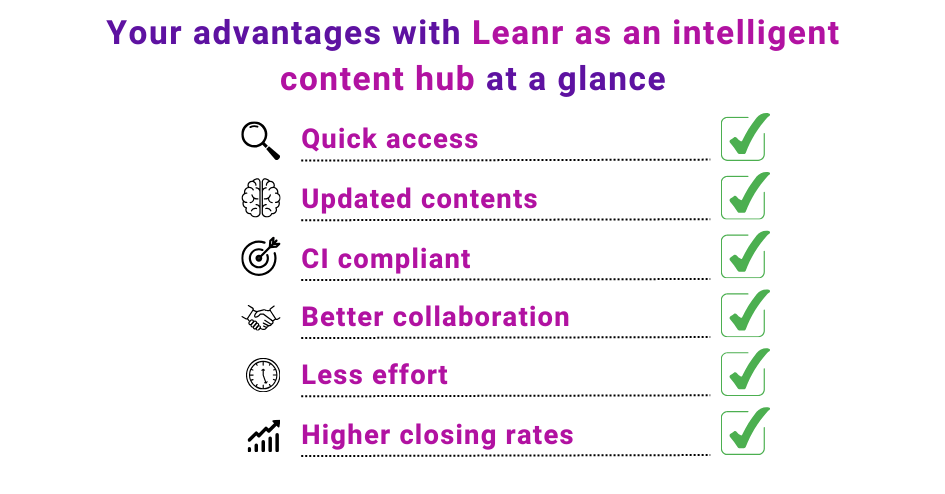
Companies with a systematic sales enablement approach achieve a 15% higher closing rate than companies without dedicated enablement measures (CSO Insights Sales Enablement Report, 2020). At the same time, companies that use sales enablement tools report a reduction in preparation time for customer appointments of up to 65% (Forrester TEI Study Seismic, 2020). These figures impressively demonstrate that structured presentation systems enable measurable business success.
The implementation of a specialized solution not only changed the technical processes, but also the work culture: marketing teams retain control over brand management while spending less time on administrative tasks. Sales staff can concentrate on what they do best – selling. A central content hub enables seamless access to all relevant materials.
| Feature | Intranet & Co. | Leanr – Intelligent Content Hub |
|---|---|---|
| Provision of presentations | ✔ | ✔ |
| Slide library | – | ✔ |
| Presentation builder | – | ✔ |
| Review process & audit trail | – | ✔ |
| Collaborative presentation creation | – | ✔ |
| Labeling, search & filter functions | – | ✔ |
| Structuring & control of slides | – | ✔ |
| 1-click update of many presentations | – | ✔ |
| Public & private folder structures | – | ✔ |
| Chat per presentation for exchange | – | ✔ |
| Automatic notifications | – | ✔ |
The human success factor: Why technology alone is not enough
The best presentation management software in the world is worthless if it is not accepted by employees. Successful implementations are characterized by three critical factors that go far beyond technical specifications.
Transparent communication about the benefits of new ways of working creates acceptance, while practical training provides the necessary security. The Capgemini Change Management Study 2023 shows that companies that promote the development of their employees are on average 25 percent more successful in implementing change (Capgemini, 2023). This is not just about operating the software, but also about understanding new processes.
It is also crucial that managers lead the way as role models and actively support the change. Change management is not a nice-to-have, but a must-have. Companies that neglect this aspect often find that new systems work technically, but are not used in practice. Successful change management requires a well thought-out strategy and continuous support for employees.
The future of presentation management
While artificial intelligence is revolutionizing many areas, presentation processes are often still years behind. Companies that invest in modern presentation management solutions today gain a measurable competitive advantage. There is a clear trend towards intelligent, self-learning systems that not only manage content, but also make recommendations.
The requirements are not getting any less demanding: customers expect professional, personalized content. Compliance requirements are becoming stricter. Teams are increasingly working remotely and need access to up-to-date materials at all times. At the same time, the pressure to prove the ROI of content investments is increasing.
Conclusion: time for a new presentation culture
Presentations are too important to be left to chance. They are decisive for the conclusion of contracts or project successes, shape the corporate image and influence strategic decisions. Nevertheless, in many organizations they are still treated as a minor matter – an approach that is no longer up to date in view of the increasing importance of professional communication. Particularly affected are sectors such as management consultancy, pharmaceuticals, technology companies and financial service providers, where presentations are used daily as a central means of communication.
SharePoint and traditional intranet solutions have their place – but not when it comes to managing dynamic presentation processes. Companies that want to remain successful in times of increasing demands need solutions that have been specially developed for these complex challenges. Professional change management plays a decisive role in the success of implementation.
The question is not whether presentation management will modernize – but whether your company wants to be a pioneer or a laggard. Early adopters benefit not only from more efficient processes, but also from a competitive advantage that translates into better customer conversations and higher sales.
Want to learn how Leanr can revolutionize your presentation processes? Arrange a free demo today and experience the difference for yourself.