


How much does inefficient document management really cost your company?
Documents are the backbone of all business communication, yet many teams spend a significant portion of their work time searching for the right version, seeking approvals via email, or manually reconciling content across multiple systems. What may seem at first glance like a minor organizational issue has concrete consequences for productivity, quality, and compliance.
Documents in Everyday Business Life: The Real Problem Lies in the Process
Imagine the following situation: A sales representative is preparing for an important client meeting. She searches for the latest product presentation but finds three different versions on three different platforms. None of them is clearly marked as approved. She decides to use the file with the most recent date, but it isn’t the most recently approved compliance version. Similar situations arise every day in companies that manage documents and presentations without a well-thought-out system.
The fundamental problem is not a lack of diligence on the part of individual employees, but rather a lack of structure: content is created in a decentralized manner, stored in various locations, and distributed without a standardized version control system. The more departments are involved, the greater the risk of inconsistencies.
Three Common Inefficiencies Without Structured Document Management
In practice, unstructured document management regularly leads to three measurable problems:
Version Chaos: When marketing, sales, and compliance teams work on their own versions of the same file, parallel versions are created. Outdated or unapproved documents end up being used externally, which is particularly critical in regulated industries such as banking and insurance, where any deviation from approved content can have legal consequences.
Unclear Division of Responsibilities: When the coordination of document updates is managed via email, tasks can easily get lost. It remains unclear who is responsible for which changes and when a document is considered reviewed.
Cumbersome review processes: Gathering feedback via email chains is time-consuming and difficult to track. This leads to lengthy processing loops, especially when multiple reviewers are involved and every change triggers a new approval process.
Document Management System: What a Modern System Must Be Able to Do
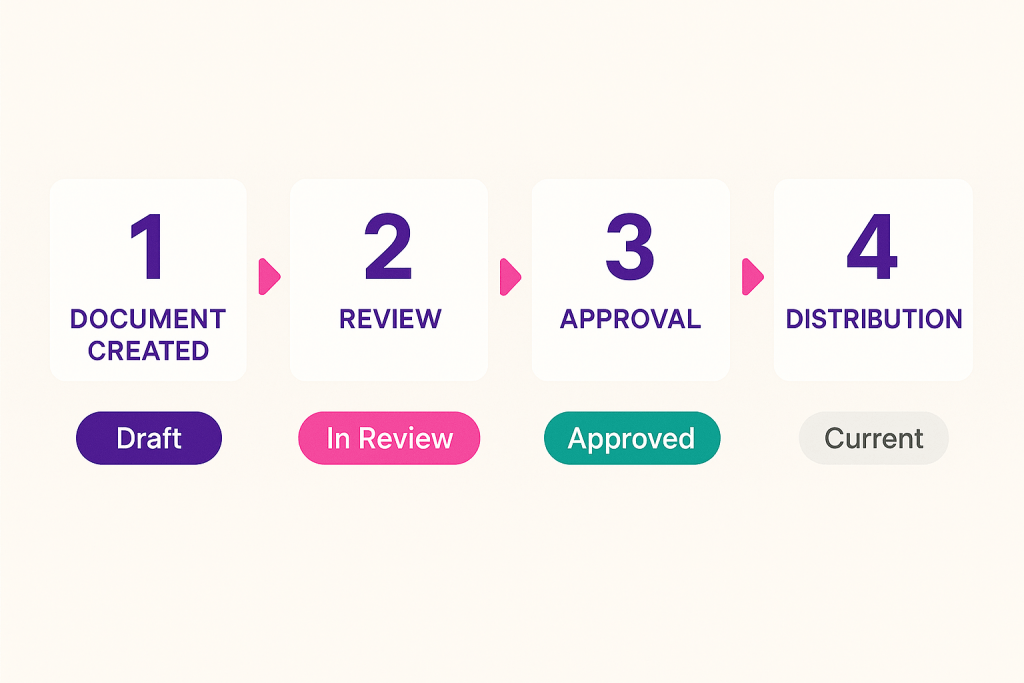
A modern document management system goes far beyond a structured folder-based filing system. It automates recurring tasks, consistently manages access rights, and ensures that users always work with the most recent approved version without having to actively search for it.
The key features of a high-performance system include:
- Automatic Version Control: The system manages any number of versions, ensuring that authorized users always access the correct, approved version without having to take any manual action.
- Role-Based Access Control: Not every employee needs to be able to access or edit all content. A clearly defined access control and role structure ensures that documents are modified only by authorized individuals.
- Centralized Accessibility: Intuitive search, filter, and tagging features significantly reduce the time spent searching for documents.
- Complete audit trail: Changes and approvals remain fully traceable, which is particularly crucial for compliance requirements under frameworks such as MiFID II or BaFin regulations.
- Process Automation: Routine tasks such as updating linked content or the date-based release of new versions are performed automatically.
Why Traditional Tools Like SharePoint Are Reaching Their Limits
Many companies rely on SharePoint, intranet solutions, or shared drives for their document management. These systems provide a basic filing structure but are not designed to meet the requirements of dynamic document management. Approval processes must be managed manually, version history is difficult to track, and the ability to locate specific content depends on the individual filing practices of each team. As the company grows or compliance and timeliness requirements increase, these system limitations quickly become apparent. For a more detailed analysis of this topic, see the article “Why Traditional Presentation Management Is No Longer Sufficient.”
How does cross-location collaboration benefit from a centralized system?
In companies with multiple locations or hybrid work models, the challenges described above become even more acute. Departments such as marketing, sales, and compliance have different requirements and rarely follow the same processes. A centralized document management system consolidates all relevant processes in one place: tasks are assigned with clear delineation, review processes run without email communication, and a compliance-compliant audit trail makes changes traceable for all stakeholders.
For companies in regulated industries, this last point is particularly relevant: Any change to an approved document triggers a documented process that is archived in an audit-traceable manner. This is not a matter of organizational preference, but is often a regulatory requirement.
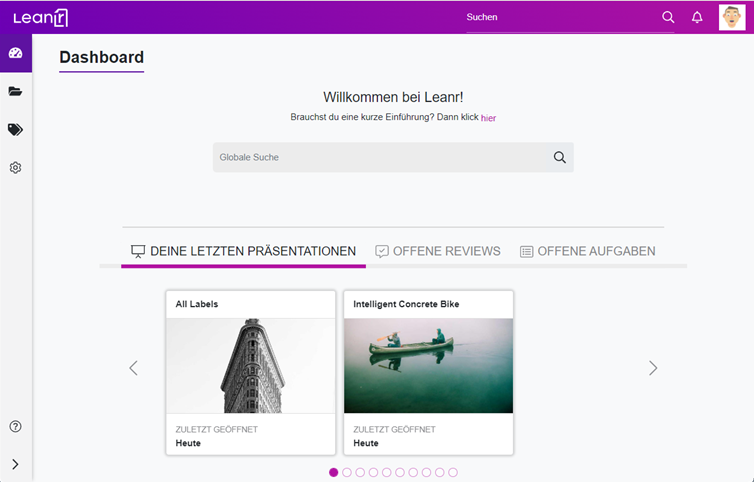
A central content hub like Leanr makes it possible to standardize this entire process: When a slide or section of a document is updated, the system automatically identifies the other documents in which that element is used and allows for a consistent update with a single click.
Benefits of Document Management: What Companies Actually Gain
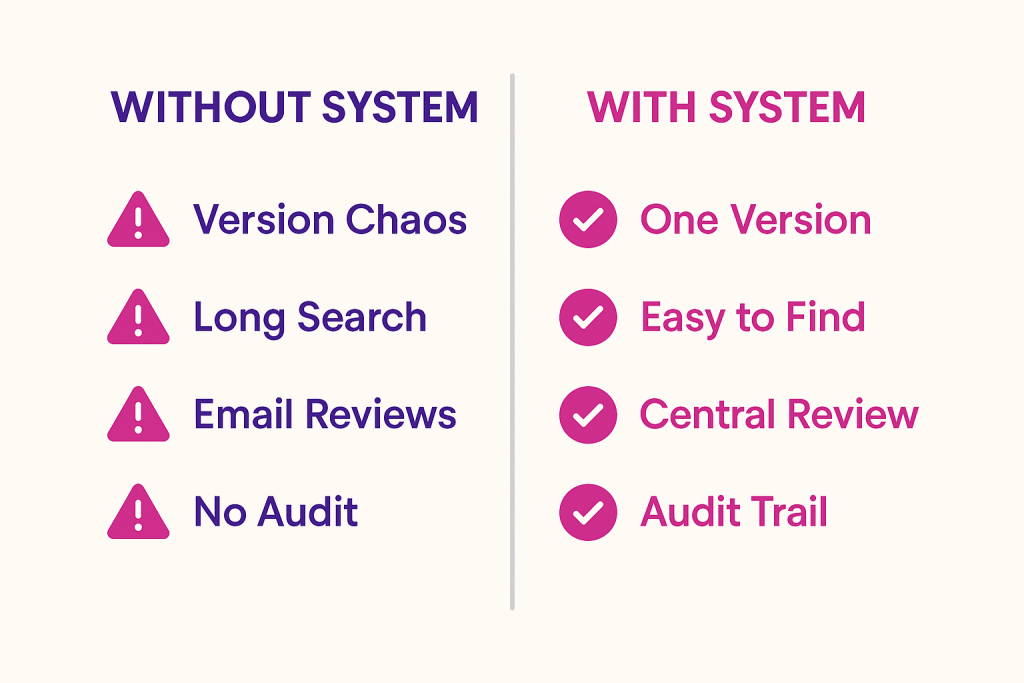
The benefits of a structured document management system can be described in three dimensions:
Time Savings Through Automation: Based on experience with a central content hub, presentation management can save an average of up to 50 percent of processing time. The reason: Routine tasks such as manual updates, searching for the latest versions, and coordinating approvals are largely eliminated. The time saved is then redirected to core activities in marketing and sales.
Quality assurance through control: When all users access the same approved version and cannot modify locked content on their own, the risk of errors and brand inconsistencies is significantly reduced. This is particularly important for companies whose sales representatives frequently create their own presentations and, in doing so, unintentionally deviate from approved templates.
Compliance Assurance Through Traceability: A complete audit trail and change log document all changes, approvals, and accesses. In regulated industries, this is not an optional convenience, but a prerequisite for compliant processes. Even PDFs—which are often underestimated as static documents—must be integrated into such processes: Without an automated system, PDF documents must also be updated and redistributed manually, which creates opportunities for errors and poses compliance risks.
For an in-depth look at compliance requirements in sales—particularly in the banking and insurance sectors—see the article “Compliance-Compliant Sales Presentations.”
Usage Statistics as a Management Tool
One often underestimated advantage of modern document management systems is presentation-specific usage statistics. They show which documents and content are actually being used and which contribute to closing sales. This makes it possible to identify outdated or ineffective content and optimize it in a targeted manner. This makes document management not just an administrative tool, but an active control mechanism in sales.
As an intelligent presentation management hub, Leanr consolidates precisely these processes into a single application. Automated version control, role-based access control, an audit-proof audit trail, and a modular system based on the “need-to-know” principle all work together seamlessly. You can determine exactly how much your company could save by using the ROI calculator.
Conclusion
Inefficient document management causes measurable losses in terms of time, quality, and compliance in companies. Scattered storage locations, a lack of version control, and manual approval processes are not inevitable aspects of everyday work, but rather problems that can be solved through structural changes. Modern document management systems automate routine tasks, ensure that users are always working with the correct version, and provide the traceability that regulated industries absolutely require. Companies that take this step not only save time but also gain greater control over the quality of their communications.
If you’d like to see how this works in practice, you can schedule a demo to get a clear idea of what it’s like.
Frequently Asked Questions (FAQ)
What is a document management system? A document management system is a software solution that structures and largely automates the creation, storage, management, sharing, and archiving of documents within a company. The goal is to ensure that authorized users can access the correct, currently approved version at any time without having to search for it or coordinate manually.
What are the advantages of intelligent document management over traditional filing systems? Traditional storage solutions such as network drives or SharePoint provide storage space, but no process-based control. Intelligent systems automate version control, approval processes, and updates; manage access rights on a role-based basis; and ensure that changes are fully traceable via an audit trail. This significantly reduces manual effort and minimizes the risk of inconsistencies.
Is centralized document management relevant only for large companies? No. While complexity and the effort required for coordination do increase with company size and the number of locations, even medium-sized companies benefit from clear versioning processes, unambiguous access rights, and structured approval workflows. These requirements are particularly relevant in regulated industries such as financial services and insurance, regardless of company size.
How does document management support compliance in regulated industries? In regulated industries such as banking and insurance, documents must contain verifiably approved information, and changes must be documented in an audit-proof manner. An intelligent system ensures that restricted content cannot be modified independently, that approval processes are fully logged, and that a complete audit trail is available for external audits, such as those required under MiFID II or BaFin regulations.
What happens if the content of a central document needs to be updated? In a modern document management system, the software automatically identifies the documents in which specific content is used and allows for consistent updates with a single click. This prevents outdated content from remaining in individual documents and minimizes the effort required for company-wide changes.