


What Does Sales Enablement Mean for Modern Sales?
Sales teams are under constant pressure to succeed. Yet a significant part of the problem lies not in the conversation with the customer, but in what happens beforehand: Presentations are put together at the last minute, each employee relies on different sources, and no one can be sure whether the slide being used is still up to date. This is exactly where sales enablement comes in: It creates the organizational and technical conditions that allow sales teams to invest their time in sales conversations, not in searching for documents.
Why Do Sales Teams Fail Without a Clear Enablement Strategy?
The term “sales enablement” refers to all measures, processes, and tools that help sales representatives conduct customer meetings effectively and close deals. That may sound abstract at first. In concrete terms, it means: Who has access to which materials? Who ensures that presentations are up-to-date, complete, and compliant with regulations? How can new content be quickly and reliably delivered to sales representatives?
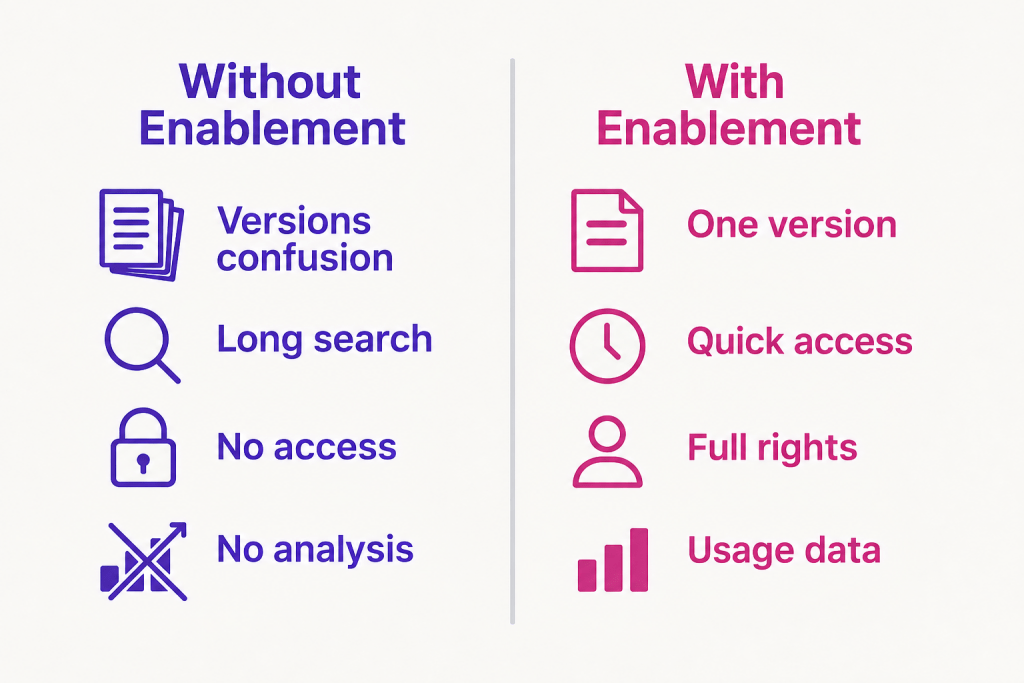
In practice, this fails due to a simple yet far-reaching reality: content is scattered across email distribution lists, network drives, SharePoint folders, and local hard drives. A sales representative looking for the latest product presentation shortly before an important client meeting might find three different versions from different time periods. Which one is the current version? None of the three has a clear version date, the colleague in charge is on vacation, and time is running out.
This scenario is no exception. It is a structural reality in many medium-sized and large companies. The consequences are clear: In highly regulated industries such as banking and insurance, the use of unauthorized presentations can lead to legal sanctions, fines, or reputational damage. Approval processes involving multiple departments and compliance teams make the situation even more complex. Those who fail to manage sales presentations in a structured manner risk not only compromising efficiency but also regulatory compliance.
What are the key components of an effective enablement strategy?
Sales enablement is not a single tool, but rather the interplay of several dimensions. Anyone who wants to approach it in a structured way should focus on the following areas:
Access Rights and Role-Based Architecture
Not every employee needs access to all content. A well-designed role-based system determines who is allowed to view, edit, or download which presentations. This not only saves time when searching but also prevents outdated or unauthorized materials from being used in client meetings. In practice, this principle is often referred to as the “need-to-know” principle: Each person sees exactly what they need for their task.
Version Control and Release Processes
Presentations are not static products. Prices change, product features are updated, and new regulatory requirements are introduced. Without structured version control, parallel versions emerge that contradict each other in terms of content and damage the brand image. A robust sales enablement system ensures that there is always only one valid version and that changes are traceable through a defined approval process.
Customization Within Clear Boundaries
Sales representatives need the flexibility to tailor presentations to each specific customer: to insert the company name, identify the contact person, and highlight a specific offer. At the same time, mandatory slides—such as disclaimers, regulatory notices, or required sections—must remain unchanged. The tension between sales flexibility and structural constraints is one of the key challenges in sales enablement. Solutions that incorporate controllable degrees of freedom address precisely this issue: certain content is locked, other content is customizable, and the boundaries can be defined on a case-by-case basis.
Usage Analysis and Continuous Improvement
Sales enablement doesn’t end with providing materials. Which presentations are actually being used? Which slides lead to conversions, and which ones are regularly skipped? Presentation-specific usage statistics make it possible to identify outdated or less effective content and refine it in a targeted manner. Without this transparency, there is no foundation for data-driven decisions in sales.
How do sales software and structured processes work together?
A common misconception is that sales enablement can be achieved simply by implementing software. In fact, the opposite is true: without a defined process in place, a new tool merely shifts the existing chaos to a different platform. Sales software only realizes its full potential when it is built on a clear organizational foundation. This means: defined roles and responsibilities, agreed-upon update cycles, and clear approval workflows.
Those who consistently follow this approach will see measurable results: Routine tasks such as updating slides, replacing attachments, or distributing new versions can be automated. Instead of manually navigating through folder structures, sales representatives can find the relevant materials in seconds using intuitive search, filter, and label structures. This eliminates duplicate work, reduces errors, and ensures a consistent public image.
In the context of sales enablement, it’s also worth taking a look at compliance-compliant presentations in sales: Especially in regulated industries, the technical safeguarding of approval processes is not an optional convenience, but a structural requirement.
What role do sales presentations play in the enablement process?
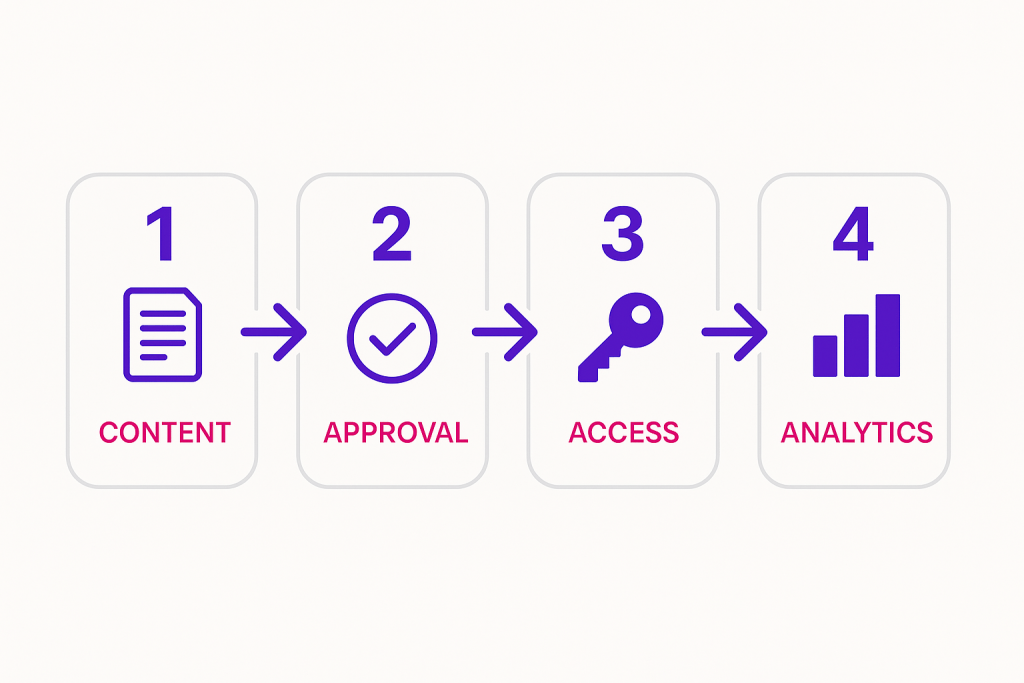
Sales presentations are the most visible result of an effective enablement process. They are the moment when all the upstream processes—content selection, approval, and customization—come together with the customer. That is precisely why poorly managed sales presentations directly reflect weaknesses in the overall process.
An inconsistent design, an outdated product feature, or a missing disclaimer: None of these errors arise during a customer conversation, but rather hours or weeks beforehand, when processes are unclear and responsibilities aren’t clearly defined. Conversely, those who structurally embed sales enablement ensure that sales presentations are available in the correct version at the right time and can be customized within clear boundaries.
A structured modular solution, in which sales representatives assemble their presentations from a central library of approved slides, significantly reduces preparation time while ensuring that no unapproved content is circulated. For teams looking to further optimize this process, the article on efficient collaboration when creating presentations shows how real-time collaboration and structured reviews ensure quality.
What does a central presentation management hub do for sales enablement?
The challenges described—lack of version control, unclear access rights, manual update efforts, and a lack of transparency regarding usage—can be structurally addressed through a central content hub that consolidates all presentation processes in one place. Such a system not only manages file storage but also controls the entire lifecycle of a presentation: from creation and review to controlled distribution and the measurement of actual usage.
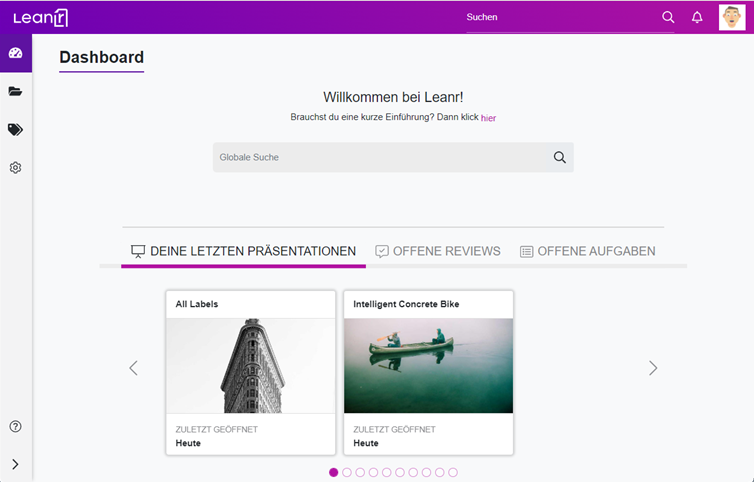
With an intelligent presentation management hub like Leanr, you can control approvals with a single click, lock slides as required, and automate customizations using variables—all without violating compliance requirements. The “degrees of freedom” concept makes it possible to precisely define, for each role and context, what leeway is allowed in presentation design and what elements remain fixed.
As an intelligent presentation management hub, Leanr orchestrates all processes related to the creation, updating, approval, and delivery of sales presentations within a single application. Sales teams always work with the latest, approved version, while compliance teams retain full control over mandatory content. Whether for DZ Privatbank, Fürstlich Castell’sche Bank, or mid-sized sales organizations, Leanr can be implemented on a turnkey basis without time-consuming IT coordination. The ROI calculator shows the specific cost-saving potential this can offer your organization.
Conclusion
Sales enablement is not a software project, but rather an organizational approach that combines structured processes, clear responsibilities, and the right tools. Managing sales presentations centrally and in compliance with regulations reduces errors, protects the brand image, and frees up the time sales teams need to focus on the actual conversation with the customer. Especially in regulated industries, a well-thought-out enablement strategy is not merely a convenience but a structural necessity. It is crucial that the chosen solution not only manages content but also maps out the entire presentation process, from creation to measuring usage.
If you’d like to see what structured presentation management might look like in your sales organization, schedule a demo.
Frequently Asked Questions (FAQ)
What is sales enablement, and why is it important for B2B companies? Sales enablement refers to all measures that help sales representatives better prepare for and conduct customer meetings more efficiently. It is particularly relevant for B2B companies because their sales teams rely on extensive, sometimes regulated materials, the management of which can be extremely time-consuming without structured processes.
How are sales presentations and sales enablement related? Sales presentations are the most important tool for direct customer interaction and, as such, the most visible manifestation of the entire sales enablement process. Effective sales enablement ensures that these materials are up-to-date, approved, compliant with regulations, and easy to find before the customer meeting begins.
What risks arise in regulated industries without structured sales enablement? In industries such as banking and insurance, unapproved or outdated presentations can lead to regulatory sanctions, fines, and reputational damage. A lack of compliance documentation during audits by regulatory authorities is another specific risk arising from a lack of version control and unclear approval processes.
What distinguishes a presentation management system from a simple file storage system? A file repository stores files. A presentation management system controls the entire lifecycle: Who is authorized to edit what, which slides are required, which version is the latest, who approved it, and which materials are actually being used? A file storage system alone cannot handle these aspects.
Does implementing sales software require a lot of effort? That depends on the solution you choose. Modern systems can be designed to enable a smooth onboarding process without lengthy IT projects: Upon request, the implementation team will handle the technical setup, the configuration of the system, the migration of existing content, and the training of the teams. In addition to the technical implementation, accompanying change management is crucial for long-term success to ensure a high adoption rate within the sales team.